
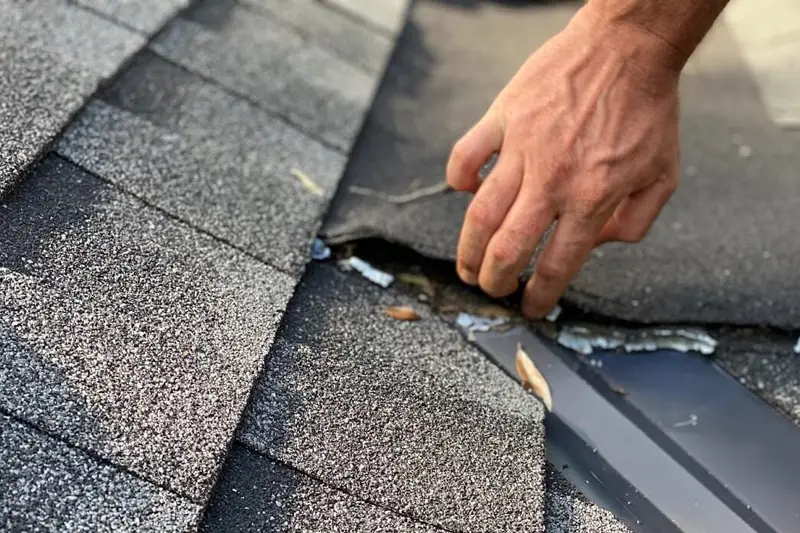
Why roof-to-wall joints struggle in sideways rain
A roof field sheds water in one direction. A roof-to-wall joint is a three-dimensional boundary where roofing, sheathing, framing, and cladding all meet. That complexity creates weak points that wind-driven rain can exploit.Common stressors in North Texas include:- Gusty thunderstorms that push water laterally under shingle edges.
- Microbursts that reverse normal flow paths for a few seconds and force water behind flashing.
- Debris in gutters that backs water up at the sidewall and over tops the step flashing.
- Thermal expansion that opens hairline gaps in sealants and siding joints.
The sual suspects at leaking sidewalls
- Missing or misinstalled step flashing
- No kick-out flashing at the base
- Counterflashing or siding trim that does not cover the step flashing
- Gutter end cap or apron gaps
- Aging underlayment and dried sealants
Early signs you can spot
- Staining or bubbling paint on the ceiling or wall below a roof-to-wall intersection.
- Swollen trim where a lower roof dies into a two-story wall.
- Dark streaks on brick or stucco beginning at the gutter return.
- Drips that only appear during wind-driven storms, not every rain.
How Apple Roofing diagnoses sidewall leaks
A thorough repair starts with a thorough diagnosis. Here is what our Plano-based teams look for on a service visit:- Roof and wall layout
- Flashings
- Kick-out condition
- Water pathway testing
- Interior moisture mapping
- Adjacent system check
- Documentation
Permanent fixes that work in Texas weather
Rebuild the step flashing correctly
We remove a wide enough area of shingles and wall finish to expose the joint. New step flashing is installed one piece per shingle course, with proper wall and roof legs, and with fasteners placed in the roof leg only. Overlaps are shingle-style, never back-lapped.Add or upsize the kick-out flashing
The kick-out is bent to throw water cleanly into the gutter. In heavy wind zones, a larger kick with a crisp diverter edge performs better, and we tie this work into any required roof installation scope so the assembly remains warrantable.Integrate counterflashing or wall trim
For brick, we cut a clean reglet kerf and install counterflashing that laps the step flashing and is sealed in the kerf. For siding, we integrate trims and housewrap to shingle over the step flashing, not under it.Refresh underlayment at the sidewall
A self-adhered membrane is ideal here. It creates a watertight bridge between roof deck and wall sheathing and resists capillary movement during sideways rain; when the roof covering is aged, we may recommend a partial or full roof replacement to integrate the details properly.Tighten up the gutter return
We reseal or replace end caps, check apron flashing, and ensure the first hanger does not distort the gutter at the joint.Vent, cable, and conduit penetrations
Where utilities run along a sidewall, we add saddle flashings and sealant backer rods. Sideways rain finds these tiny penetrations first.Finish and cleanup
We replace only the siding or trim necessary, color-match sealants, and leave clear photos showing the new shingle-style layering so you can see the permanent fix.Materials that raise the bar
- Self-adhered flashing membrane for sidewall tie-ins and kick-out backing.
- Painted aluminum or galvanized steel step flashing sized to match shingle exposure, never undersized.
- Masonry counterflashing in a kerf rather than face-sealed only.
- Quality sealants used as a supplement, not as the primary waterproofing.
Prevention checklist for homeowners
You can reduce sideways rain risk with a few habits between professional inspections:- Keep gutters and the first two feet of roof valley clean so water does not back up at sidewalls, our tips on how to clean your gutters make this a safe weekend task.
- Watch the base of tall walls where lower roofs tie in. If you do not see a pronounced kick-out, ask for an inspection.
- After major storms, look for new interior stains below roof-to-wall intersections.
- Trim back branches that brush the sidewall. Repeated rubbing loosens trims and flashing covers.
- Schedule a roof checkup each spring and fall. Flashings move with temperature swings more than shingles do.
Storm prep for North Texas
- Before severe-weather season, photograph roof-to-wall areas (kick-outs, gutter ends, dormers). Photos help document pre-storm condition for insurance.
- Clear downspouts and confirm the downspout next to the sidewall discharges freely; clogs here back-flood the joint.
- Secure loose trim on siding and fascia. Sideways rain exploits flexing trim pieces.
- Cut back vegetation to create at least a 18–24″ work and drying gap along sidewalls.
- After a major cell moves through, if you see shingle displacement or wet drywall, book our storm damage repair so we can stabilize and correct the sidewall assembly.
What makes sideways rain tricky to “seal” from the outside
It is tempting to caulk every visible gap. Sealant has its place, but it cannot fix reversed overlaps or missing step flashing. In a storm, water can travel uphill along surfaces through capillarity. The only durable solution is to restore the correct shingle-style layering so gravity and overlap do the work, even when wind tries to cheat the path. For ongoing education and updates, browse our roofing news & tips category.When to call Apple Roofing
If you have any of the warning signs above or your home has complex roof-to-wall areas near tall walls, chimneys, or dormers, a professional inspection is worthwhile.Our Plano team works on these details every week and carries the materials to correct them on the first visit in many cases, start with a quick free inspection request.Apple Roofing Address: 3001 E Plano Pkwy #100, Plano, TX 75074 Phone: (469) 908-4323 Website: https://appleroof.com/Related guides: how to find and fix a roof leak, the storm hose test, roofing terms like step flashing and kick-out, roof storm damage.
Coverage depends on your policy, and your insurance carrier makes coverage decisions. Apple Roofing provides insurance claim support: we document damage with photos and a written report you can share with your carrier, and we explain what the documentation shows. Learn more about our insurance claim support.
FAQ
What is kick-out flashing and why is it essential?It is a specially angled piece at the base of a roof-to-wall joint that kicks water from the sidewall into the gutter. Without it, water rides the wall into the cladding and leaks inside.Can I add kick-out flashing without replacing shingles?Sometimes, but a proper installation usually requires removing a few shingle courses and wall trim to integrate it correctly.Will new caulk stop a sideways rain leak at a sidewall?Caulk is a short-term patch. Durable repairs replace or re-layer step flashing, add or fix the kick-out, and integrate counterflashing or siding trims over the metal, not beside it.How fast should I act after noticing stains?Right away. Sidewall leaks can wet insulation and sheathing quickly. The earlier the fix, the smaller the repair area and cost.For structural or flashing work, consult a licensed roofing contractor so the work is installed correctly and warranty coverage is maintained.If you are dealing with a leak or storm damage, Apple Roofing can inspect your roof and explain what we find. Our free 8-point roof inspection checks the shingles, valleys, ridge cap, chimney, ventilation, drip edge, flashing, and roof penetrations. We photograph what we find, explain it, and give you a written report, with no pressure to commit. That is what we mean by A Sweeter Roofing Experience.
Apple Roofing is a GAF-certified installer, residential work is backed by our 7-year workmanship warranty, and we take emergency calls 24 hours a day. Schedule a free roof inspection or call (866) 277-5388.